Freight/Signal
Compliance · AI · Tools · A Logixtecs Publication
Issue 16 · September 1, 2026

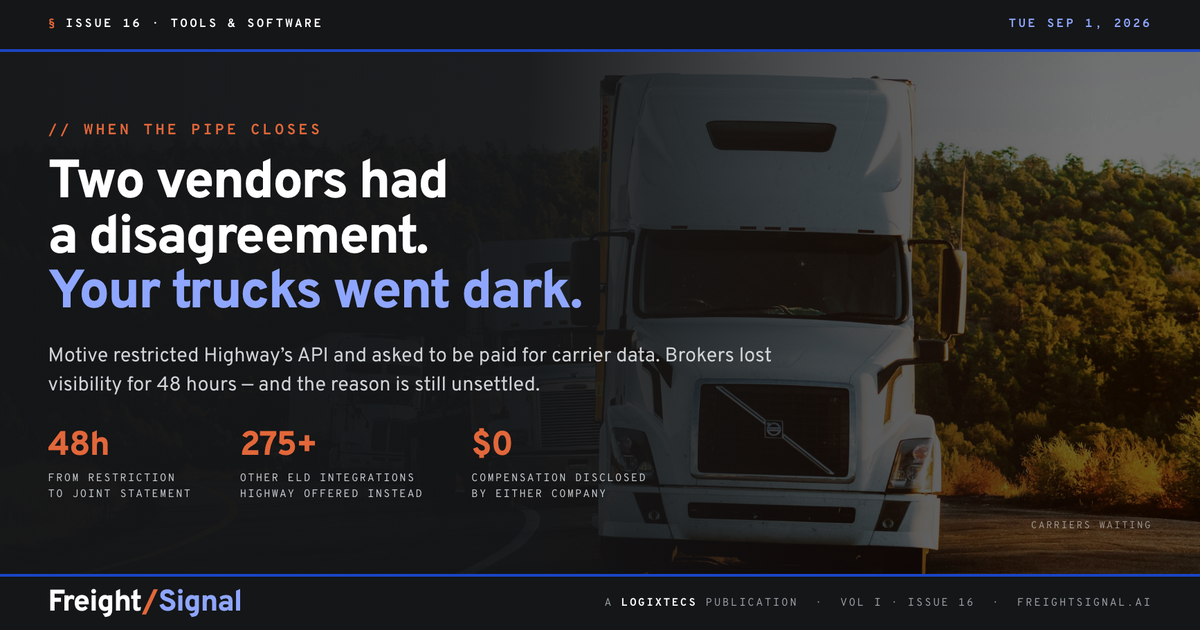
Two vendors had a disagreement. Your trucks went dark

Freight/Signal
Vol. 1 · No. 16 · Tuesday, September 1, 2026
Tools & Software · A Logixtecs Publication
 

Good morning.

Last Tuesday we counted an FMCSA list and found a device can stop being legal without anyone calling you.

This week the same thing happened commercially, in 48 hours, and the reason is still unsettled.

The Cold Open

Some time before August 27, Motive restricted Highway’s API access and told Highway it would have to pay for access to carrier data.

Highway vets carriers for brokers, reading ELD data with the carrier’s authorization. When the pipe narrowed it emailed its brokerage customers: Motive data now refreshes less often, Load Lock Alerts are unavailable for those carriers, and their freight is no longer covered by Highway’s Performance Guarantee — the backstop under which Highway puts its own capital behind its verification. That risk went back to the broker mid-week, by email.

On August 28 the two issued a joint statement. Access restored. “No action is required from carriers or brokers.”

The statement mentions no compensation, licensing, or money in either direction, and the contract has not been rewritten — the companies say they are “in discussions to update their existing agreement.”

The pipe is open. The reason it closed is open too.

The Market Read
Diesel · today
$5.71
national avg · 1,707 stations · Aug 31
EIA weekly
$5.652
on-highway · up 3.6%
California
$7.22
+$1.51 over national
Five-week move
+10.1%
since July 20

INDICATIVE FIGURES. NOT A SUBSTITUTE FOR PAID INTELLIGENCE.

The Call

Two consecutive weeks of roughly 3.6% — and the second posted before Brent crossed $90. Brent was $88.68 on August 28 and $90.59 on August 31, after a U.S. strike on Iranian launchers on the Strait of Hormuz, which carries about 20% of the world’s oil. Crude was climbing before the strike, so this is a trend the index is behind, not a shock it missed. The index looks backwards; the pump does not.

Three Signals
1
Broker transparency reached the White House.

FMCSA sent its broker transparency rulemaking to OIRA on August 27 — RIN 2126-AC63, docket FMCSA-2023-0257, amending 49 CFR Part 371. It is the first concrete movement since comments closed in March 2025, after the agency missed both a May and a July target.

What to do Nothing yet — the text stays confidential until it clears, and it is still only a proposed rule. EO 12866 caps review at 90 days, so it becomes readable this year.
2
The CDL enforcement wave got much bigger.

USDOT shut down 110 CDL schools over English-proficiency violations, and DHS swept roughly 200 schools, targeting DMV employees and motor carriers over unqualified drivers. Separately, three more states ended their non-domiciled CDL programs.

What to do A driver who trained at a closed school does not automatically lose the credential — but the file will be looked at. Pull training records now, not at audit.
3
UCR fees rise about 20% for 2027.

A final rule published August 31 raises Unified Carrier Registration fees an average of 20% over the 2025/2026 structure, from $9 to $9,329 per entity depending on fleet size, to cover a projected $21.79 million funding shortfall. FMCSA took 34 comments, many opposed.

What to do Small for a small fleet, real for a large one. Budget it before January rather than meeting it at registration.

Sources: FreightWaves, Overdrive, CDLLife, Transport Topics.

The Deep Dive · Tools & Software

You are not a party to the agreement

One sentence from last week, repeated exactly once: the federal process that removes an ELD from the registry never mentions the motor carrier. Last week that was a regulatory finding. This week it is a commercial one, and it moved faster.

Motive and Highway have a contract. You are not in it. But the data is yours, and it moves because you authorized it — both companies said so, framing the resolution around “carrier authorization” and “carrier choice.” Your authorization was never in dispute. The price of honoring it was.

Integration is not a feature you bought. It is a relationship between two companies that can be repriced.
And you will learn about it from whichever one loses.

That is structural, not one company behaving badly. Your vetting platform depends on your ELD vendor. Your TMS depends on both. None of those dependencies appear in the contract you signed, or on any dashboard you can audit.

The same week, Descartes bought Tai for $100 million and Abu Dhabi’s Mubadala took a majority stake in Arrive Logistics. Those are the slow version of the same event: the roadmap, the integrations and the support terms change owner, and nobody asks the fleet.

The fast version took 48 hours and ended with a joint statement that resolved the outage without resolving the question. Which means it can recur, on the same terms, tomorrow.

Read the broker docket →
Tool of the Week
WATCH · UNCHANGED

Highway — revisited, twelve weeks on

Type
Carrier vetting
Effort
Medium
Risk
Upstream dependency

In Issue #4 we reviewed Highway and gave it WATCH. The reasons were enterprise pricing with no public number, and vendor lock-in.

The lock-in was real. It was just one layer up from where we pointed it.

We meant the broker’s lock-in to Highway. What actually bit was Highway’s dependency on Motive — and the customer who felt it was the broker, who had no contract with Motive at all. We named the right risk at the wrong layer, and it is worth saying so plainly.

Highway’s response is the most useful thing here: it integrates with more than 275 other ELD providers and offered discounted alternatives. That tells you what to ask any vetting, telematics or TMS vendor before you sign:

1. Which of your integrations are contractual, and which run on goodwill?
2. What happens to your guarantee when one goes dark?
3. Will you tell me, or will I notice?

Highway’s guarantee lapsed for affected carriers and that exposure returned to the broker automatically. Highway emailed its customers the same week — that is the behaviour you want, and it is not the default.

Verdict stays WATCH. The product did what it should. The rating is about the stack it sits in.

Rule Watch · next 30 days
Aug 31
UCR 2027 fee increase — final rule published. ~20% average, $9–$9,329 per entity.
Filed
Ongoing
Broker transparency at OIRA since Aug 27 (RIN 2126-AC63). EO 12866 caps review at 90 days.
Watch
Ongoing
English-proficiency enforcement — 110 CDL schools closed, ~200 swept.
Live
Ongoing
Non-domiciled CDL programs — three more states exited this week.
Watch
Ongoing
Teamsters v. California DMV — driverless-truck rules challenged; permits still moving.
Watch

Registry note: Overdrive reports MOTUS granting and suspending authority against stale data — two carrier suspensions with active insurance on file, one brokerage grant with no bond. Same failure family as the ELD registry gaps we counted last week: the list is the system of record, and the list is wrong.

Question of the Week
Has an integration ever gone dark on you — and how did you find out?

I want the mechanism, not the vendor name — email, dashboard, or a driver calling from a dock. Hit reply; I read every one.

Off the Dock
Next Tuesday — AI in Freight. Fleets are buying AI driver coaching to work camera footage no human has time to watch. The pitch is fewer incidents and a better CSA score. I will ask what it actually changes — the score, the premium, or just the volume of video somebody still reviews.
— Aman Singh, editor

If you buy software for a fleet, the three questions in Tool of the Week are worth forwarding. It is free and there is nothing to sign up for.

Read past issues
Corrections: reply to this email — they run in the next issue.
Role preferences: reply and tell me what you run; I will tune what you get.
Freight/Signal
A Logixtecs Publication · Established 2026 · California
Vol. 1 · No. 16 · Primary sources cited inline